Widow’s plea for rule change on overloaded lorries
Denise Oscroft saw her husband Steven die right next to her – when a lump of concrete fell from a lorry, smashed through their car windscreen and struck his head. Nobody has ever been prosecuted for his death. Now Denise wants to prevent other people being killed or injured…
Denise Oscroft saw her husband Steven die right next to her – when a lump of concrete fell from a lorry, smashed through their car windscreen and struck his head. Nobody has ever been prosecuted for his death. Now Denise wants to prevent other people being killed or injured in the same way.
“They haven’t only took Steve’s life away; they’ve took my life away as well.”
Steven and Denise Oscroft had been married for almost 37 years when he was killed on what should have been a happy family day out.
The couple had taken two of their grandchildren strawberry picking and had stopped off for ice cream on their way home to Shirebrook, in Derbyshire.
As Steven was slowly driving around a sharp bend, they passed a tipper lorry travelling in the opposite direction.
“I seen a rock coming from the truck, turned my head, looked at the windscreen,” says Denise, pausing.
IMAGE COPYRIGHT
NOTTINGHAMSHIRE POLICE
Two of Steven Oscroft’s grandchildren were in the back of the car when he died, on 7 July 2020
Steven’s inquest heard that, in that split second, there was a crash as a concrete slab, measuring 20cm (7in) and weighing 8.5kg (18lbs), flew through the windscreen, hitting him.
His injuries were catastrophic and he died at the point of impact.
The car slowed to a complete stop.
“[I] just looked at Steve and got the children out of the car,” says Denise.
A taxi driver stopped to help and called the emergency services while Denise rang her two daughters, Becky Marsh and Kelly Kirby.
“I just says ‘The kids are all right’. I couldn’t tell them that their dad was dead,” says Denise who is sitting beside her daughters as she recalls the events of 7 July, 10 months later.
Kelly and Becky quickly arrived to support their mum at the scene.
“We just [thought] you needed a lift home or my kids were upset or something like that,” says Kelly. “We had no idea what had really happened or how bad it was.”
IMAGE COPYRIGHT
NOTTINGHAMSHIRE POLICE
The broken concrete slab was about 20cm wide and weighed 8.5kg
The driver of the tipper lorry was long gone. He did not stop at the scene and may not have realised the lump of concrete had fallen off his lorry.
Denise’s young grandson drew a picture of the lorry, colouring it orange and blue.
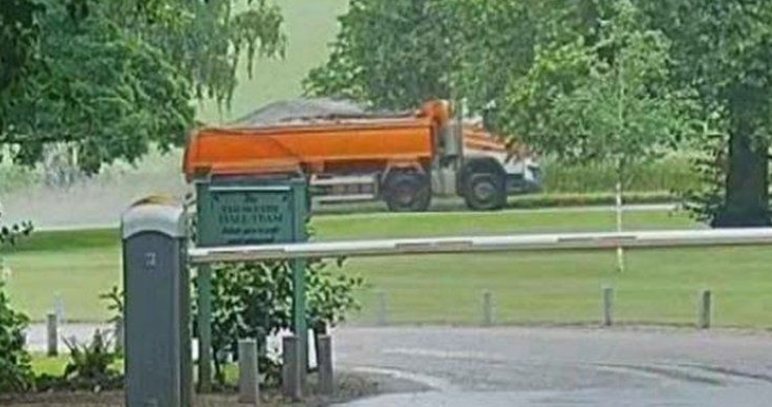
And after trawling through CCTV and automatic number plate recognition (ANPR) footage from roads close to the scene of the accident – near Thoresby Hall, in Nottinghamshire – police were able to identify an orange-coloured lorry belonging to Paul Wainwright Construction Services.
Police found the company’s lorry load was mounded high above the sides of the vehicle, and only part of the load was covered by netting.
“That load wasn’t safe,” says Denise. “If it [had] been safe that rock, or what they call it concrete, wouldn’t have gone through our car window and killed my husband.”
IMAGE COPYRIGHT
THORESBY HALL
The lorry’s load was mounded above the sides of the vehicle, and only part of the load was covered by netting
Police arrested the 64-year-old driver on suspicion of causing death by dangerous driving, but did not have enough evidence to prove the concrete had come from his lorry. The driver, therefore, was not charged.
However, when an inquest was held, Assistant Coroner Gordon Clow found as a fact, on balance of probabilities, that the piece of concrete had fallen from this lorry.
In fact, he was so concerned about the company’s practices for loading vehicles he sent what is known as a Report to Prevent Future Deaths, asking them to take action to stop other people being killed.
Paul Wainwright Construction Services did not want to comment to the BBC. However, Paul Wainwright himself gave evidence at the inquest and maintained the concrete did not fall from one of his company’s lorries. The lorry driver who was arrested also gave evidence and said he did not believe his vehicle had shed any of its load that day.
Timber fell from a lorry and killed a driver in East Sussex in May 2020 – two months before Steven Oscroft died
It’s not unusual for objects to fall from vehicles and cause impacts. In fact, the Highways Agency (now known as Highways England) reported more than 22,000 “road impact incidents” caused by objects falling from vehicles in one year alone.
A lot of the time these incidents result in vehicles being damaged, or journeys being delayed while roads are closed – but they also kill.
Highways England reported that an “overloaded or poorly-loaded vehicle or trailer” was a contributory factor in 31 road deaths in 2018. This data is only for major A and M roads in England (the ones managed by Highways England), so the figure for all roads was potentially higher.
People to have lost their lives in recent years include a “wonderful father” hit by timber which fell from a lorry and went through his windscreen, and a female pedestrian hit by a generator which fell from a lorry.
Another driver described how she was inches away from being impaled by a steel pole which crashed through her windscreen after falling from a lorry.
“It’s happening too often,” says Denise.
“Once is too often,” adds Becky.
IMAGE COPYRIGHT
FAMILY PHOTO
Becky Marsh (right) said one death like her father’s is one too many
Since Steven died his family keep noticing lorries, owned by various different companies, carrying loads they believe are unsafe. Denise has even stopped some lorry drivers and spoken to them.
“In their eyes it’s safe, but it’s not safe,” she says.
“They are still coming through Shirebrook knowing what they’ve done to our family, still piled high with their loads. But in their eyes they are not doing nothing wrong.
“You can see it [the load] actually hanging over the sides but they say ‘With the weight of it, I can assure you it won’t fall out’. But it fell out that day and it killed my husband.”
IMAGE COPYRIGHT
FAMILY PHOTO
Steven Oscroft was a “doting grandad” to four grandchildren
The coroner also sent his Report to Prevent Future Deaths to the Driver and Vehicle Standards Agency (DVSA), asking them to take action to prevent deaths like Steven’s.
He is particularly concerned about the practice of mounding loads above the sides of tipper lorries, and using sheets which do not completely cover loads. He has asked the DVSA to consider changing its guidance for lorry drivers – which is what Steven’s family want the DVSA to do too.
“We want it to be clearer,” says Becky. “It’s very vague … it just says ‘it must be secure’.
“There’s nothing that says it must be flat, it must be sheeted. It’s just not clear enough for drivers or anyone else to interpret.”
In a statement, the DVSA said: “We were sorry to hear of the tragic death of Steven Oscroft and wish to extend our sympathies to his family and friends.
“We will of course fully support the coroner in ensuring lessons are learnt from this accident.”
Both the DVSA and Paul Wainwright Construction Services must respond to the coroner by 8 July, setting out a timetable for action.
In the meantime, Denise has a message to other lorry drivers.
“Just make sure your loads are safe and secure, because it’s blood on your hands if it happens.”


