

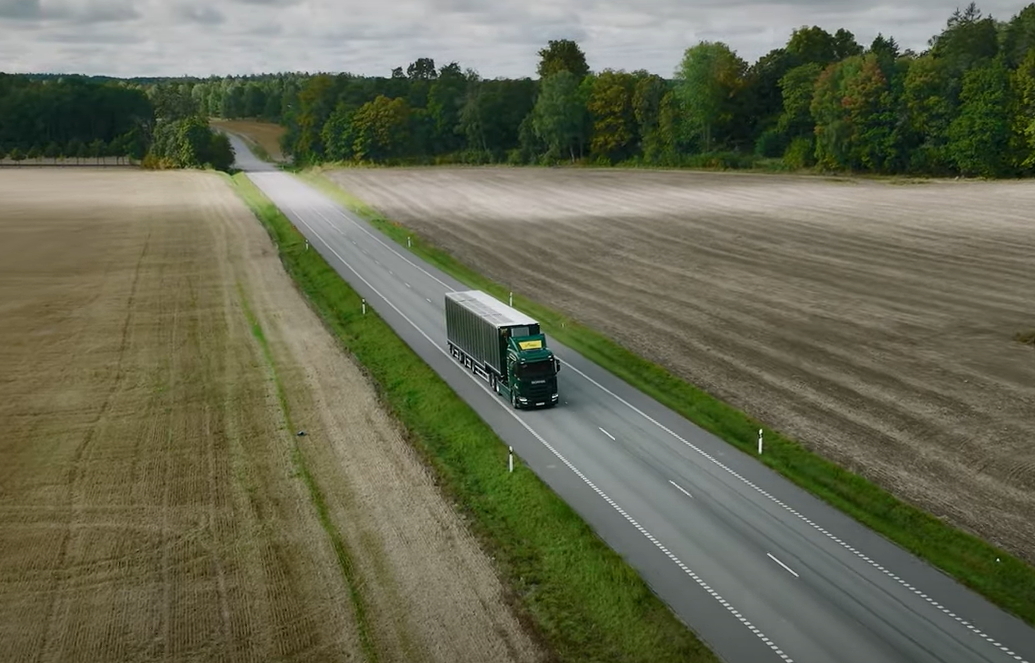
A groundbreaking experiment involving a cutting-edge hybrid truck equipped with a solar-panel-clad trailer is currently undergoing testing on public roads. This pioneering initiative is the result of a comprehensive two-year research partnership that brings together key players in the transportation and energy sectors, including Scania, Uppsala University, Eksjö Maskin & Truck, Midsummer, Ernsts Express, and Dalakraft.
At the heart of this endeavor is a formidable 560-horsepower plug-in hybrid truck. Adorning the 18-meter trailer is an impressive 100-square-meter expanse of ultra-thin, lightweight, and highly flexible solar panels, boasting a peak efficiency rating of 13.2 kWp (kilowatt peak). When operating in Sweden, these panels are expected to generate a substantial 8,000 kWh of energy annually. The truck’s power ecosystem is complemented by a battery system boasting a total capacity of 300 kWh, with 100 kWh residing in the truck itself and a substantial 200 kWh housed in the trailer.
This ambitious project is not limited to simply harnessing solar power; it also delves into the realm of pioneering research on innovative tandem solar cells. These cutting-edge cells are a product of a harmonious fusion between Midsummer’s established solar cell technology and the promising capabilities of perovskite solar cells. This partnership is poised to yield heightened efficiency in the conversion of sunlight into electricity.

Scania, one of the project’s driving forces, is deeply committed to advancing the transition towards a sustainable transportation system. The integration of solar panels into a truck’s powertrain is a novel approach that holds the promise of significantly reducing emissions in the transport sector. Stas Krupenia, Head of the Research Office at Scania, emphasizes the significance of this venture, stating, “It is great to be at the forefront in developing the next generation’s trucks.”
The hybrid truck is serving as a vital tool in a comprehensive research initiative aimed at assessing the impact of generated solar energy and quantifying the reduction in carbon emissions attributable to the solar panels. The research team has also taken significant strides in the development of highly efficient, lightweight solar panels tailored for the unique demands of trucks. Additionally, they are exploring the intricate dynamics of how trucks can seamlessly interface with the power grid, laying the groundwork for potential scenarios where multiple such trucks are interconnected.
One pivotal aspect of this project involved evaluating the implications for the electricity grid, including the feasibility of selling surplus energy back to the grid. The concept of two-way charging, although promising, remains a complex challenge with unclear legislative parameters. Sverker Ericsson, an Electrical Trade Engineer at Dalakraft, shares his perspective, saying, “We thought we could purchase surplus energy from the trucks; unfortunately, that is not currently possible. However, the integration of solar cells into the truck’s energy supply is a fantastic step forward. As an electricity trading company, we recognize the vital role of all renewable energy sources in navigating the ongoing energy transition.”


