

Russian airship manufacturer Aerosmena is set to introduce its lenticular-designed airship with a 600-ton payload capacity in 2024.
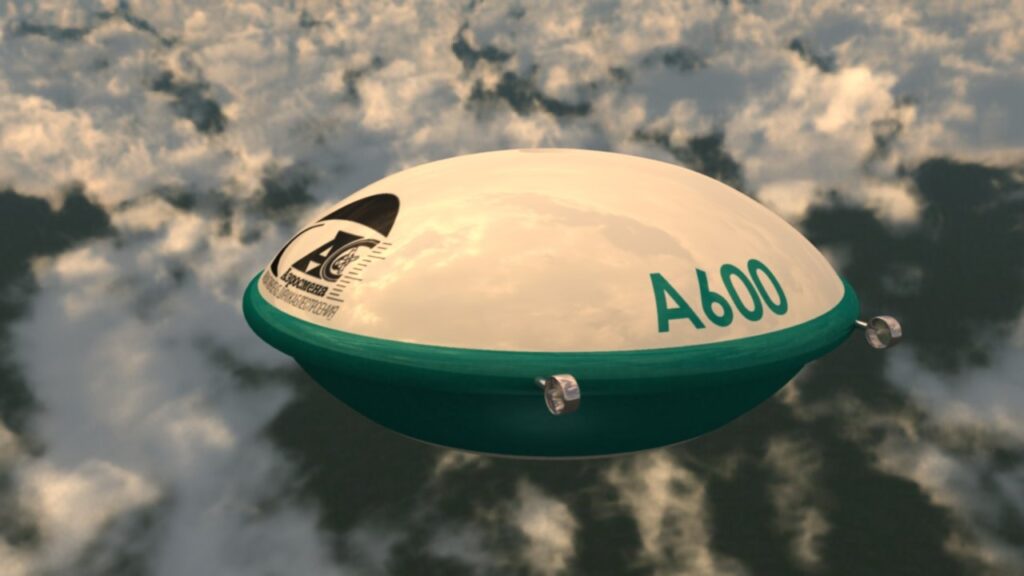
This innovative aircraft is engineered for transport and logistics tasks, eliminating the need for traditional infrastructure like ports, roads, and runways. The distinctive “flying saucer” design enhances maneuverability and crosswind landings compared to conventional elongated airship models.
The Airship Initiative Design Bureau Aerosmena (AIDBA), led by accomplished Russian aircraft designer Orfey Kozlov, spearheads the development of these large payload transport airships. The concept relies on thermal ballasting and an advanced steering system, with design insights drawn from wind tunnel studies and mathematical modeling.

Aerosmena envisions a family of airships capable of carrying payloads ranging from 20 to 600 tonnes, contingent on acquiring international airworthiness certification. The airship’s potential lies in providing door-to-door logistics solutions, bridging the gap for communities in remote areas without established infrastructure.

These airships boast an impressive non-stop flight range of up to 8,000 km, cruising at 250 km/h. The unique external sling design enables loading and unloading while hovering at the destination, streamlining cargo transport to remote locales.

Featuring a stable aerodynamic lenticular design and auxiliary helicopter engines, Aerosmena’s airship meets global airworthiness standards. The platform not only minimizes logistical costs but also emphasizes environmental sustainability.
Additionally, these airships can be employed for humanitarian and environmental initiatives, such as firefighting and disaster relief. The design employs two gas chambers for lift, utilizing helium for buoyancy and hot air for payload elevation.
Aerosmena’s groundbreaking airship design heralds a new era in efficient, environmentally conscious logistics and transportation solutions.



Aerosmena lenticular thermoballasting airships for transport goods in the air. . .
Russia has designed a new type of ships capable of moving across plains, mountains and prairies at record speeds, without the need to go through ports. Aerosmena has produced the first-generation aircraft carrier, and will perform their duties in the trade exchange of rough, hard-to-reach areas. Leha with traditional ships and planes. It has the capacity to load, transport and unload 600 tons in each trip.
This type of aircraft is originally similar to ancient balloons, including two gas chambers to provide lift power. 620,000 cubic meters of helium, it has large cavities filled with air heated to 200°C (392 Fahrenheit), equipped with eight helicopter engines. It gives it a drive power of 8,000 kilometers (approximately 4970 miles), and speeds of up to 250 km/h (155 knots), meaning it’s tens of times faster than cruise ships. The engines of such aeroplatforms can turn almost 360 degrees, which means that in the form of such a flying machine there are no the “front” and “back” sides. Thus, such an airship has the ability to change direction, simply via the goaling travel course by the thrust vector adjasting.
These ships are no longer a hit of imagination, they have been preceded by remote drones, and air cargo ships will open a new window to dry ports in closed countries, which have no considerable views of the seas and oceans. Those dry ports will have their international systems, styles and agreements in dealing with land transport ships floating at heights that blow the mind. Aircraft market capital is expected to reach $1 billion by 2024-5. The undeclared race for aircraft carrier projects will gain widespread operational momentum.
In conclusion: This magnificent image has become a reality, and is on its way to spread in the Arctic, Africa, Latin America, the Antarctic continent, Asia, and the Pacific. These expectations are no longer a far-fetched dream, but closer to reality in the next few years.