


Authorities in Belgium have arrested a former top counter-narcotics official being investigated for suspected involvement with a ring that concealed 11.5 tons of cocaine in cargo shipped from Guyana to the port of Antwerp, in a case revealing how law enforcement corruption is crucial to moving massive amounts of drugs into Europe.
On October 27, police discovered the 11.5 metric tons of cocaine with an estimated wholesale value of about $530 million in a container of scrap metal from Guyana that arrived at the Antwerp port, according to a police news release and a tweet. The seizure was one of the largest ever recorded in Europe, according to the news website VRT.
The discovery occurred after a two-part operation on September 28 and October 1, according to a press release by Belgium’s Federal Prosecutor. The former head of counter-narcotics of Belgium’s Gendarmerie, Willy Van Mechelen, and a scion of the Belgian-Italian Aquino crime family were both arrested in the operation, according to reporting by De Standaard, though neither has been formally charged in the drug trafficking case. More than two dozen other people were also arrested, including three police officers.
The news website reports that the arrests provided police with information that a large shipment of cocaine was on its way from South America, which led investigators to the Guyanese cargo.
An investigation into this criminal network began in October 2019, after the seizure of 2,800 kilograms of cocaine in Antwerp in a container bound for Maasmechelen, home to the Aquino crime group.
Corruption of law enforcement is not a new concern in Belgium. In 2018, Antwerp’s mayor, Bart de Wever, said the scale of cocaine trafficking through the city’s port was so vast the corruption of local politicians was inevitable. In 2019, a large-scale drug investigation ended with the arrest of two police officers and led security services to highlight drug gangs’ growing infiltration of law enforcement.
At the time, Thierry Gillis, who heads Antwerp’s Police General Inspectorate, told De Staandard that “the pressure on individual police officers is increasing… [c]riminals have ever-increasing sums of money. Some police officers cannot resist that call”.
In recent years, European ports have made historic cocaine seizures, particularly in Antwerp, which, as Europe’s primary port of entry for drugs, seized a record 61.8 metric tons of cocaine in 2019. The latest interdiction raises the volume of cocaine seized in 2020 to over 54.5 metric tons, rapidly nearing 2019’s record.
InSight Crime Analysis
The current boom in South American cocaine supplies and European demand for the drug — coupled with increased security at key European ports — mean the role of colluding customs officials, port authorities and police has grown.
While the collusion of a high-level official in Europe is striking, Van Mechelen, the former head of the counter-narcotics division of Belgium’s Gendarmerie, has been arrested in the past. He was indicted for drug trafficking in 2001, the same year the Gendarmerie was abolished.
The arrests of three active police officers may be the more important development, as it is more representative of current trends. Antwerp has become more favorable to drug traffickers than Rotterdam, with the less automatized nature of Antwerp’s port (over Rotterdam or Hamburg) raising the value of corruptible human workers. The risks are high, but colluding workers in Antwerp can earn 75,000 to 125,000 euros ($85,000 to $142,000) per drug shipment they help move, according to De Volkskrant.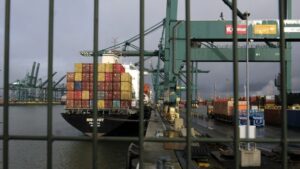
Corrupt police officers represent a serious obstacle to law enforcement efforts like Antwerp’s “Stroomplan” (Flow Plan), launched in February 2018 to help coordinate local and federal police and authorities in counternarcotics operations. It was just one year before that that Antwerp’s Federal Judicial Police Chief warned that criminal networks were on their way to infiltrating key positions within business, customs, law enforcement and judicial institutions.
What’s less clear is how to solve this type of collusion. A 2020 report from the Council of Europe’s anti-corruption agency recommends raising current, inadequate levels of funding for federal anti-corruption units and implementing “integrity checks” during police officers’ careers, particularly when they are recruited to sensitive divisions such as counternarcotics.
However, similar problems can be found in countries that have already implemented such recommendations. Recently in the Netherlands, for example, an anti-corruption investigation led to the arrest of a former police officer who shared information on containers in the port of Rotterdam with a cocaine-trafficking network.
